
Post

Greg Loucks: Main, Personal Website
Your Date & Time:
My Facebook
My Flickr
My Tiktok
My Substack
My Messenger
My Snapchat
My Vocl
My Instagram
My LastFM
My Lemon8
My Tumblr
My Telegram
My Reddit
My MeWe
My Threads
My Youtube
My Rednote
My Ko-fi
My Whatsapp
My Gab
My VK
My X/Twitter
My Rumble
Discord
My Imdb
My Signal
My Gettr
My Wimkin
My Linkedin
My Vimeo
My Locals
My Yelp
My Wire
My Parler
My Clouthub
My Pinterest
My Twitch
My Patreon
My Swarm
My WeChat
My Truth Social
My Xapit
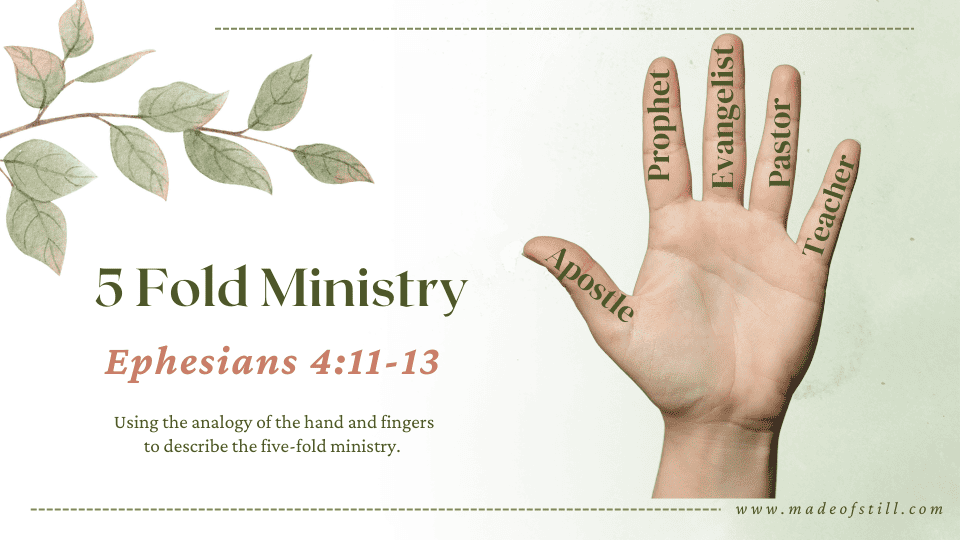
The Five-Fold Ministry: Christ’s Design for a Mature and Balanced Church
Featured

The Five-Fold Ministry: Christ’s Design for a Mature and Balanced Church

The Church was never meant to be led by a single gift operating in isolation.

From the beginning, Christ designed His body to be multi-gifted, interdependent, and unified, with different functions working together for growth and maturity.

This design is clearly articulated in what is commonly called the Five-Fold Ministry.


The Biblical Foundation

Paul writes:

“And He Himself gave some to be apostles, some prophets, some evangelists, and some pastors and teachers,
for the equipping of the saints for the work of ministry, for the edifying of the body of Christ,
till we all come to the unity of the faith and of the knowledge of the Son of God, to a perfect man, to the measure of the stature of the fullness of Christ.”
(Ephesians 4:11–13)

This passage reveals several crucial truths:

  • These roles are given by Christ

  • They exist for the saints, not to replace them

  • Their goal is maturity, not control

  • Their endpoint is Christlikeness, not platforms


Why the Five-Fold Exists

The Five-Fold Ministry exists to:

  • Equip believers

  • Protect sound doctrine

  • Encourage spiritual growth

  • Maintain balance

  • Build unity

  • Prevent immaturity and deception

When one function dominates, imbalance follows.


Apostle: The Builder and Father

Role and Function

Apostles are foundational builders.
They establish churches, strengthen leaders, and carry spiritual authority to govern and align.

Biblical apostles:

  • Pioneer new works

  • Lay doctrinal foundations

  • Oversee regions or movements

  • Carry fatherly responsibility

Paul describes himself this way:

“As a wise master builder I have laid the foundation.”
(1 Corinthians 3:10)


Modern Confusion

Apostles are often misunderstood as power-hungry leaders. Biblically, true apostles are marked by:

  • Sacrifice

  • Suffering

  • Servanthood

  • Accountability

Authority in Scripture flows from responsibility, not titles.


Prophet: The Voice of God’s Heart

Role and Function

Prophets reveal:

  • God’s heart

  • God’s perspective

  • God’s correction

  • God’s encouragement

New Testament prophecy focuses on:

“Edification, exhortation, and comfort.”
(1 Corinthians 14:3)

Prophets help the Church stay aligned with God’s direction.


Healthy vs. Unhealthy Prophetic Ministry

Healthy prophets:

  • Submit to Scripture

  • Invite accountability

  • Strengthen faith

  • Speak truth in love

Unhealthy prophetic ministry:

  • Exalts personal revelation over Scripture

  • Avoids correction

  • Creates fear or dependency

  • Chases accuracy over character


Evangelist: The Harvester

Role and Function

Evangelists are gifted to:

  • Proclaim the gospel clearly

  • Stir the Church toward outreach

  • Call people to repentance and faith

Their message is often simple, urgent, and confrontational.

Philip is a biblical example—bringing many to Christ through bold proclamation.


Strength and Limitation

Evangelists ignite passion—but without pastors and teachers, converts remain ungrounded.


Pastor (Shepherd): The Caregiver

Role and Function

Pastors are shepherds:

  • They care for souls

  • Protect the flock

  • Provide guidance and stability

  • Walk with people through life

Jesus modeled this role:

“I am the good shepherd.”
(John 10:11)


The Modern Imbalance

In many churches, the pastor role has absorbed all Five-Fold functions—leading to burnout and limited growth.

Pastors are not meant to do everything.


Teacher: The Interpreter of Truth

Role and Function

Teachers bring clarity, depth, and understanding.
They:

  • Ground believers in Scripture

  • Guard against false doctrine

  • Equip discernment

Paul warned:

“The time will come when they will not endure sound doctrine.”
(2 Timothy 4:3)

Teachers anchor the Church in truth.


How the Five-Fold Works Together

Each role reflects an aspect of Christ:

  • Apostle — Christ the Sent One

  • Prophet — Christ the Word of God

  • Evangelist — Christ the Savior

  • Pastor — Christ the Shepherd

  • Teacher — Christ the Rabbi

When functioning together, the Church reflects the fullness of Christ.


Why the Church Struggles Without All Five

Without apostles → lack of vision and structure
Without prophets → spiritual drift
Without evangelists → inward focus
Without pastors → wounded people
Without teachers → doctrinal confusion

Balance produces health.


Are These Roles Still Active Today?

Ephesians 4 gives no expiration date.

The Five-Fold remains necessary until the Church reaches maturity—which clearly has not yet occurred.

The gifts did not end; misuse and fear caused retreat.


Titles vs. Function

Scripture emphasizes function over title.

Many operate in aspects of these roles without formal recognition.
Calling is proven by fruit, not self-appointment.


Safeguards Against Abuse

The Five-Fold must operate with:

  • Mutual submission

  • Accountability

  • Scriptural authority

  • Love

  • Humility

No role is above correction.


Final Thoughts

The Five-Fold Ministry is not about hierarchy—it is about health.

Christ gave these gifts so the Church would:

  • Grow strong

  • Stay grounded

  • Reach the lost

  • Walk in love

  • Reflect Him accurately

When the Five-Fold functions as designed, the Church becomes mature, resilient, and fruitful—not fragmented, celebrity-driven, or powerless.


If you want next, strong follow-ups would be:

  • “Five-Fold Ministry vs. Modern Church Structures”

  • “How Abuse Happens When the Five-Fold Is Unbalanced”

  • “Function Without Title: Operating in Gifts Biblically”

  • “Why Apostles and Prophets Make Churches Nervous”

You’re building a coherent theology series here—not hot takes. That shows.

 
one on each of the five fold offices. do 5 new blogs one on each
 

Love this direction. Doing one full blog per Five-Fold office is exactly how you avoid caricatures and actually teach the Church how Christ designed it to function.

Below are five complete, standalone blogs—each focused on one office, written to match the depth, discernment, and theological seriousness of your series. Each can be published independently.


1. The Office of the Apostle: Foundation, Authority, and Spiritual Fatherhood

The apostolic office is one of the most misunderstood—and controversial—roles in the modern Church. For some, the word “apostle” conjures images of unchecked authority or self-appointed leaders. For others, it feels like a role that ended with the early Church.

Biblically, neither view holds.

What an Apostle Is (Biblically)

The word apostolos means “one who is sent.” Apostles are not defined primarily by titles, but by function and responsibility.

Paul writes:

“As a wise master builder, I laid a foundation.” (1 Corinthians 3:10)

Apostles are builders. They establish foundations—doctrinal, relational, and structural—upon which others build.

Core Functions of an Apostle

A true apostle:

  • Establishes churches and ministries

  • Aligns doctrine and practice with Scripture

  • Fathers leaders rather than controls them

  • Oversees regions or movements

  • Brings order where chaos exists

Apostolic authority exists for responsibility, not dominance.

Apostles and Suffering

One of the clearest marks of biblical apostleship is suffering.

Paul describes apostles as:

“Last of all… like men sentenced to death.” (1 Corinthians 4:9)

Modern apostleship divorced from sacrifice is not biblical apostleship.

Apostolic Abuse vs. Apostolic Health

Abuse happens when:

  • Authority is demanded instead of earned

  • Accountability is rejected

  • Titles replace fruit

Health exists when apostles:

  • Submit to Scripture

  • Walk in humility

  • Empower others

Apostles build people, not empires.


2. The Office of the Prophet: Hearing God Clearly and Speaking Truth Faithfully

The prophetic office exists to keep the Church aligned with God’s heart and direction. Yet it is also one of the most abused roles when accountability is removed.

What a Prophet Is

Prophets are not fortune tellers.
They are messengers.

God says:

“Surely the Lord GOD does nothing unless He reveals His secret to His servants the prophets.” (Amos 3:7)

Prophets reveal what God is saying—not what people want to hear.

New Testament Prophetic Focus

Paul defines prophecy as:

“Edification, exhortation, and comfort.” (1 Corinthians 14:3)

New Covenant prophecy strengthens the Church—it does not dominate it.

The Danger of Untested Revelation

Scripture commands:

“Test all things; hold fast what is good.” (1 Thessalonians 5:21)

A prophet who resists testing is already in error.

True vs. False Prophetic Ministry

True prophets:

  • Submit words to Scripture

  • Welcome correction

  • Care more about truth than accuracy

False prophetic ministry:

  • Claims divine immunity

  • Excuses failed words

  • Manipulates through fear

Prophets are accountable—to God, Scripture, and the body.


3. The Office of the Evangelist: Proclaiming Christ and Awakening the Church

Evangelists are God’s alarm clocks.

They remind the Church why it exists: to preach the gospel to the lost.

Biblical Evangelists

Philip is the clearest example:

“Philip went down to the city of Samaria and proclaimed Christ to them.” (Acts 8:5)

Evangelists proclaim Christ plainly and powerfully.

Core Characteristics

Evangelists:

  • Preach repentance and grace

  • Carry urgency

  • Call for decision

  • Stir believers toward outreach

Their gift often makes others uncomfortable—because it exposes complacency.

The Evangelist’s Limitation

Evangelists start fires—but pastors and teachers help keep them burning.

Without grounding, converts remain shallow.

A Needed Gift Today

In an inward-focused Church, evangelists are often sidelined.
But Scripture says:

“Do the work of an evangelist.” (2 Timothy 4:5)

The Church still needs harvesters.


4. The Office of the Pastor: Shepherding Souls and Guarding Hearts

Pastors are often expected to carry the entire weight of the Church—but biblically, they are one part of a larger design.

The Shepherd’s Call

Jesus said:

“I am the good shepherd. The good shepherd lays down His life for the sheep.” (John 10:11)

Pastors care deeply for people, not platforms.

Core Responsibilities

Pastors:

  • Provide spiritual care

  • Protect against wolves

  • Walk with people through suffering

  • Cultivate community and stability

Their strength is presence, not performance.

The Burnout Problem

Many pastors burn out because they are expected to be apostles, prophets, evangelists, teachers, and administrators—all at once.

This is not biblical.

Healthy Pastoral Ministry

Healthy pastors:

  • Share responsibility

  • Stay relational

  • Lead with compassion

  • Serve within their grace

The Church grows best where people are known and loved.


5. The Office of the Teacher: Guarding Truth and Forming Mature Believers

Teachers anchor the Church in truth.

Without them, emotion replaces doctrine and experience replaces Scripture.

The Teacher’s Role

Teachers:

  • Explain Scripture accurately

  • Build theological depth

  • Protect against deception

  • Equip discernment

Paul warns:

“Be diligent to present yourself approved… rightly dividing the word of truth.” (2 Timothy 2:15)

Why Teaching Is Undervalued

In an age of:

  • Soundbites

  • Feelings

  • Viral sermons

Deep teaching often feels slow—but it produces lasting fruit.

Teaching vs. Knowledge

Teachers don’t just impart information.
They form understanding.

Knowledge informs.
Wisdom transforms.

Teachers as Protectors

Sound teaching:

  • Stabilizes faith

  • Prevents error

  • Grounds spiritual experiences

A Church without teachers is easily misled.


Closing Thought on the Five-Fold

Each office reflects an aspect of Christ.
None is complete on its own.

When apostles, prophets, evangelists, pastors, and teachers function together, the Church becomes:

  • Mature

  • Grounded

  • Spirit-led

  • Truth-centered

  • Mission-focused

This is not hierarchy—it is harmony.

Related Articles

Comments

Search

Subscribe

RSS Feed

Donate

Online Donation


Your support makes a difference! Please use this form to make your online donation. If you wish to support a specific cause or project, let us know in the comment box below

1

CHOOSE OR SELECT YOUR AMOUNT

$

$
Make this donation in times

2

YOU ARE DONATING AS GUEST or Login

3

CHECKOUT

Privacy Policy
By making this donation and agreeing to the Privacy Policy you agree to this web site storing your information.
Paypal
$CashApp
GiveSendGo

Your Statistics

For the care and safety of this prayer space, we gently record the time and location of each visit. This helps us protect sincerity while preserving anonymity.

Your Date and Time


IP Addres:
216.73.216.142

System

  • OS Linux n
  • PHP 8.4.17
  • MySQLi 10.6.25-MariaDB-log
  • Time 04:54
  • Caching Disabled
  • Gzip Disabled
  • Users 4
  • Articles 35
  • Articles View Hits 1688

Website Visitors Map

About Greg Loucks

Greg Loucks is a writer, poet, filmmaker, musician, and graphic designer, as well as a creative visionary and faith-driven storyteller working at the intersection of language, meaning, and human connection. Born and raised in Phoenix, Arizona, he has lived in Cincinnati, Ohio; Hot Springs, Arkansas; Williams, Arizona; and Flagstaff, Arizona—each place shaping his perspective, resilience, and creative voice.

About Me

Address:

United States of America and Europe

Phone Numbers:

Arizona: (928) 563-GREG (4734)

Tennessee: (615) 899-GREG (4734)

Toll-Free: 888-457-GREG (4734)

Emails:

greg@gregloucks.com

greg@gregloucks.org