
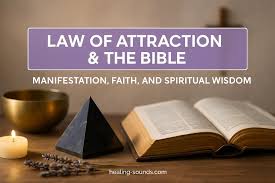
When Belief Shapes Reality — Faith, Prayer, and the Limits of Attraction
The Law of Attraction is often dismissed by Christians as New Age fantasy—or embraced uncritically by others as a substitute for God. I sit somewhere in between.
I don’t believe we “manifest reality” by sheer willpower.
But I also don’t believe belief is passive.
Scripture won’t let us.
Jesus speaks as if belief does something.
Words do something.
Faith moves something.
And yet—never as sovereign power.
So the real question isn’t whether belief matters.
The question is how, why, and where the limits are.
What the Law of Attraction Actually Teaches (For Beginners)
At its simplest, the Law of Attraction (LOA) claims:
What you consistently focus on—emotionally, mentally, and imaginatively—tends to shape your experience of reality.
Most LOA teachings include these core ideas:
-
Thoughts influence outcomes
-
Belief precedes experience
-
Emotion “charges” intention
-
Inner alignment precedes outer change
Some describe this spiritually.
Others psychologically.
Others pseudo-scientifically.
Many Christians recoil at the phrase “the universe responds.”
I do too.
But replace “the universe” with God’s created order under His sovereignty, and suddenly the Bible sounds… uncomfortable familiar.
Biblical Foundations That Sound Like Attraction (But Aren’t Control)
Jesus says:
“Therefore I tell you, whatever you ask in prayer, believe that you have received it, and it will be yours.”
(Mark 11:24)
Proverbs teaches:
“Death and life are in the power of the tongue.”
(Proverbs 18:21)
Paul writes:
“Be transformed by the renewing of your mind.”
(Romans 12:2)
James warns:
“A double-minded man is unstable in all his ways.”
(James 1:8)
Scripture consistently treats belief as formative, not decorative.
But never autonomous.
Where Law of Attraction Teachers Go Too Far
Many popular LOA teachers make a critical shift:
They move from participation → sovereignty.
Some examples:
Neville Goddard
-
Taught that imagination is God
-
Claimed “you are the operant power”
-
Treated Scripture as psychological metaphor only
Esther Hicks / Abraham
-
Frames “Source” as impersonal
-
Removes moral will
-
Eliminates suffering’s redemptive meaning
Rhonda Byrne (The Secret)
-
Reduces reality to reward mechanics
-
Ignores injustice, tragedy, and grace
-
Makes success proof of alignment
Christian faith cannot go there.
Not because belief is weak—but because God is personal.
God Is Not a Vending Machine
The Bible never promises:
“Think correctly and you’ll get whatever you want.”
It promises something harder:
“Delight yourself in the Lord, and He will give you the desires of your heart.”
(Psalm 37:4)
That verse doesn’t mean God grants pre-existing desires.
It means He reshapes them.
Which raises the question you keep circling—and rightly so:
Do we align with God’s will because we choose it… or because He already saw we would?
Scripture says: Yes.
“You did not choose me, but I chose you.” (John 15:16)
“Choose this day whom you will serve.” (Joshua 24:15)
This isn’t a contradiction.
It’s a mystery.
Can We Make Anything a Reality?
No.
And that’s good news.
Because limits protect us from illusion.
Paul prayed for healing. It didn’t come.
Jesus prayed in Gethsemane. The cup remained.
Unanswered prayer is not failed belief.
Sometimes it is deep formation.
“My grace is sufficient for you, for my power is made perfect in weakness.”
(2 Corinthians 12:9)
Quantum Mechanics: Where Science Is (and Isn’t) Relevant
Quantum physics is often abused in LOA circles, so let’s be careful.
What quantum mechanics actually shows:
-
Observation affects measurement at subatomic scales
-
Reality is probabilistic, not purely deterministic
-
Entanglement shows non-local correlation, not control
What it does not show:
-
That thoughts create matter at will
-
That consciousness commands reality
-
That desire collapses the universe into obedience
Still—quantum theory does challenge rigid materialism.
It reminds us the universe is:
-
Mysterious
-
Relational
-
Not fully visible
Which sounds… biblical.
“Now we see through a glass, darkly.”
(1 Corinthians 13:12)
Belief, Perception, and Spiritual Sight (Connecting the Threads)
This is where your earlier work on perception and spiritual sight matters.
Belief doesn’t create reality ex nihilo.
It filters reality.
Jesus says:
“According to your faith be it done unto you.” (Matthew 9:29)
Not because faith is magic—but because faith determines what we can receive.
A closed heart cannot accept grace.
A hardened mind cannot perceive truth.
A fearful spirit cannot rest.
For Seekers Who Flinch at Christianity
If “God” language feels heavy, start here:
-
Reality responds to alignment, not force
-
Integrity precedes peace
-
Love expands perception
-
Humility deepens clarity
Christianity simply insists:
Alignment is relational, not mechanical.
Prayer is surrender, not scripting.
God is Father, not field.
A Pastoral Word for the Unanswered
If you prayed.
Believed.
Spoke life.
And still lost—
You didn’t fail.
Faith is not leverage.
Prayer is not control.
Trust is not outcome management.
Sometimes the miracle is who you become, not what changes.
Where I Finally Land
I believe there is truth in the Law of Attraction.
But only as a shadow of something deeper:
A universe held together by Word,
ordered by wisdom,
responsive to faith,
but ruled by love.
Not the universe answering us—
—but God inviting us to see clearly.
“Those who have eyes to see, let them see.” (Matthew 13:16)
I. A DEVOTIONAL SERIES
Seeing Clearly: Faith, Belief, and the Shape of Reality
Format: 7 short devotionals (one week)
Each includes: Scripture · Reflection · Prayer
Day 1 — Belief Is Not Neutral
Scripture: Proverbs 23:7
“As a man thinks in his heart, so is he.”
Reflection:
Belief is not decoration on life; it is infrastructure. Long before actions change, perception changes. Jesus never treats belief as optional—because belief determines what we notice, what we expect, and what we can receive. This is not magic. It is formation.Prayer:
“God, show me the beliefs I’ve absorbed without choosing. Renew my mind where fear has shaped my sight.”
Day 2 — Prayer Is Alignment, Not Control
Scripture: Matthew 6:10
“Your will be done, on earth as it is in heaven.”
Reflection:
Biblical prayer is not scripting outcomes. It is tuning the heart. When prayer becomes about control, it collapses into anxiety. When it becomes alignment, it produces peace—even before circumstances change.Prayer:
“Father, teach me to desire what You desire—not because I’m forced, but because I trust You.”
Day 3 — The Power (and Limits) of the Tongue
Scripture: Proverbs 18:21
Reflection:
Words shape inner worlds before they shape outer ones. Scripture affirms the power of speech—but never divorces it from humility, love, or truth. Words can open doors, but they cannot replace obedience or wisdom.Prayer:
“Guard my speech, Lord. Let my words create space for truth, not illusion.”
Day 4 — When Prayer Goes Unanswered
Scripture: 2 Corinthians 12:9
Reflection:
Unanswered prayer is not evidence of weak faith. Sometimes it is evidence of deeper formation. God is more invested in who we become than in what we avoid.Prayer:
“Meet me in the unanswered places, God. Teach me trust where clarity is absent.”
Day 5 — Seeing Through a Glass, Darkly
Scripture: 1 Corinthians 13:12
Reflection:
Certainty is tempting—but clarity comes slowly. Faith does not promise full understanding, only faithful sight. Humility sharpens perception.Prayer:
“Keep me curious, God. Save me from false certainty.”
Day 6 — Faith Without Love Distorts Reality
Scripture: 1 Corinthians 13:2
Reflection:
Belief without love becomes ideology. Truth without compassion becomes cruelty. Jesus never separates clarity from mercy.Prayer:
“Let my convictions be shaped by love, not fear.”
Day 7 — The Narrow Path of Seeing Clearly
Scripture: Matthew 7:14
Reflection:
The narrow path is not about moral superiority. It’s about discernment—holding truth without losing humility, faith without losing love.Prayer:
“Lead me in the narrow way, Lord—not the loud one.”
II. A GENTLE EXPLAINER FOR SKEPTICS ONLY
Belief, Reality, and Why Christians Aren’t (All) Anti-Science
This essay is not trying to convert you.
It’s trying to clarify something that’s often misrepresented.
Many Christians reject the Law of Attraction because it sounds like wishful thinking dressed up as spirituality. That skepticism is understandable. But Christianity does not teach that belief is irrelevant—only that belief is not sovereign.
Think of belief less as creating reality and more as filtering experience.
Psychology already accepts this:
Expectations shape perception
Attention reinforces patterns
Meaning-making affects behavior
Christianity simply adds:
Reality is personal, not impersonal
Meaning is relational, not mechanical
Suffering is not always a failure
When Christians talk about prayer, they are not describing a cosmic vending machine. They are describing alignment with something outside themselves—something moral, personal, and resistant to manipulation.
If that feels less like “manifestation” and more like moral realism, you’re not wrong.
Christian faith is not anti-science.
It is anti-illusion.And it’s often more suspicious of certainty than skeptics realize.
III. VISUAL MAP
Belief → Perception → Action → Formation
Here’s a clean conceptual map you can use visually or as a graphic later:
Theological Overlay:
Belief → Faith / Trust
Perception → Spiritual sight
Action → Obedience
Formation → Christlikeness
Breakdown:
Wrong belief distorts perception
Distorted perception produces reactive action
Repeated action forms character
Character then reinforces belief
This is why Scripture focuses so relentlessly on:
The mind
The heart
What we “see”
“Do you have eyes but fail to see?” (Mark 8:18)
A Skeptic’s Q&A: Belief, Reality, and the Limits of “Manifesting”
A companion to Perception, Truth, and Spiritual Sight
Q: Isn’t this just the Law of Attraction repackaged with Bible verses?
That’s a fair concern—and the answer is no, though there is overlap worth acknowledging.
The Law of Attraction (LoA), at its strongest, observes something real:
belief influences perception, perception influences behavior, and behavior influences outcomes. Psychology, neuroscience, and behavioral economics all affirm this.Where Christianity parts ways is agency and sovereignty.
LoA often assumes:
Reality is fundamentally impersonal
Desire is authoritative
The universe responds mechanically to belief
Christian theology assumes:
Reality is personal
Desire is morally shaped
God is responsive but not controllable
So while both traditions care about belief, they disagree sharply about who (or what) is ultimately in charge.
Q: But doesn’t Christianity also say belief changes reality?
It says belief changes us, which then changes how we move through reality.
That’s an important distinction.
Christianity does not claim:
“If you believe hard enough, anything can happen.”
It claims:
“If you trust God, you will be changed—sometimes before circumstances are.”
That may sound less exciting than manifesting wealth or health, but it’s also more honest about suffering, limits, and uncertainty.
Q: Isn’t unanswered prayer proof this doesn’t work?
Only if prayer is treated as a transaction.
Many skeptics reject prayer because they were taught—explicitly or implicitly—that faith is a lever: pull it correctly and results follow. When that doesn’t happen, the system collapses.
Biblical prayer is not a lever.
It’s a relationship.That doesn’t make it immune to disappointment—but it reframes disappointment as part of formation, not evidence of failure.
Q: You talk a lot about perception. Isn’t that just subjective reality?
Partly—but not entirely.
Perception filters reality; it doesn’t create it wholesale. Two people can watch the same event and genuinely experience different things, not because truth is relative, but because attention, expectation, and trust differ.
Christianity agrees with skeptics on this much:
Humans are not neutral observers
Bias is unavoidable
Certainty is often overestimated
Where it differs is the claim that humility sharpens perception, rather than undermining it.
Q: What about quantum mechanics? Isn’t that often misused in spiritual talk?
Yes—often badly.
Quantum mechanics does not prove:
Consciousness creates reality
Thoughts collapse the universe into outcomes
Belief rewrites physical laws
What it does show is that:
Observation matters
Systems are probabilistic, not purely deterministic
Reality is stranger and less intuitive than classical models assumed
Christian theology doesn’t use quantum physics as proof—it uses it as permission for mystery. A reminder that confidence should be proportional to understanding.
Q: Why bring the Bible into this at all?
Because for millions of people, Scripture has shaped moral imagination, not just belief.
The Bible is less interested in explaining how reality works than in forming people who can live wisely within it:
People slow to speak
Careful with certainty
Oriented toward love rather than domination
You don’t have to believe it’s divinely inspired to notice its psychological insight.
Q: Ecclesiastes says the “right” is wisdom and the “left” is folly. Isn’t that just ancient superstition?
It can sound that way—especially to modern ears.
But in the ancient world, “right” and “left” were orientation metaphors, not political categories. They referred to direction, alignment, and trustworthiness, not ideology.
The text is not saying:
“People on one side are right and others are wrong.”
It’s saying:
“The wise heart is oriented toward coherence; the foolish heart drifts.”
That metaphor becomes interesting—not authoritarian—when paired with modern insights about attention, integration, and formation.
Q: Why frame this as a crisis of “seeing”?
Because disagreement today often isn’t about facts—it’s about what is noticed, trusted, or ignored.
Two people can have access to the same information and still inhabit different realities because:
They trust different sources
They prioritize different harms
They filter meaning differently
That’s not stupidity. It’s formation.
Christianity’s contribution here is not superiority, but a warning:
what we repeatedly attend to will shape what we are able to see.
Q: So what are you actually asking skeptics to consider?
Not conversion.
Just this:
That belief shapes perception more than we like to admit
That control is not the same as wisdom
That humility may be a cognitive advantage
That love might be a better test of truth than certainty
You don’t have to accept Christian theology to find value in those claims.
Q: What if I still don’t believe any of this?
That’s fine.
This work isn’t demanding agreement. It’s inviting reflection.
If nothing else, it asks a simple, uncomfortable question:
What if the deepest divide in our culture isn’t intelligence or information—but formation?
That question is worth sitting with—whatever conclusions you draw
Seeing the Same World Differently
A Dialogue Between a Skeptic and a Believer
Skeptic:
I read your essay. I didn’t hate it—which usually means I didn’t fully agree with it either. But I’m still stuck on one thing: why frame all this as “spiritual sight”? Isn’t that just a religious way of saying people disagree?
Believer:
Sometimes it is. But sometimes disagreement isn’t about opinions—it’s about what people are even capable of noticing. That’s what I mean by sight. Not eyesight. Orientation.
Skeptic:
Orientation toward what?
Believer:
Toward meaning. Toward trust. Toward whether reality is something we master or something we respond to.
Skeptic:
That already sounds like theology.
Believer:
It is—but not only theology. Psychology gets there too. So does media theory. So does neuroscience. They all say some version of the same thing: attention shapes perception, perception shapes behavior, behavior shapes identity.
Skeptic:
Sure. But where I get uncomfortable is when faith enters the picture. It feels like you’re saying belief gives you access to truth that others don’t have.
Believer:
I get why that sounds arrogant. But that’s not how I experience it. Faith hasn’t made me more certain—it’s made me more cautious. Less convinced that my first interpretation is correct.
Skeptic:
That’s not how faith usually presents itself in public.
Believer:
Agreed. A lot of what people call faith is actually certainty addiction.
Skeptic:
Okay, that’s… refreshingly honest. But let’s talk about the brain stuff. You reference left and right hemispheres. Isn’t that oversimplified pop science?
Believer:
If someone says, “The left brain is evil and the right brain is holy,” yes—that’s nonsense. But if you treat it as a metaphor for two modes of engaging reality—analytic and integrative—it becomes useful.
Skeptic:
Useful how?
Believer:
The left-hemisphere mode is great at breaking things apart, categorizing, optimizing. The right-hemisphere mode is better at context, meaning, relationships, wholes. Cultures—and media systems—can overtrain one at the expense of the other.
Skeptic:
So you’re saying we’ve overtrained analysis and undertrained integration?
Believer:
Exactly. We have infinite information and very little wisdom. Intelligence without orientation.
Skeptic:
But why bring Ecclesiastes into that? “The heart of the wise inclines to the right…” That sounds… arbitrary.
Believer:
It would be—if “right” meant political right or moral superiority. But in ancient texts, right and left were directional metaphors. Stability versus drift. Alignment versus fragmentation.
Skeptic:
So not “my side is God’s side.”
Believer:
God, no. That’s precisely the misuse I’m trying to critique.
Skeptic:
Then what is the claim?
Believer:
That wisdom is not just intelligence. It’s orientation. Toward humility. Toward coherence. Toward love.
Skeptic:
Love as an epistemology?
Believer:
In a way. Love keeps perception from collapsing into domination. It asks, “What am I missing?” instead of “How do I win?”
Skeptic:
I can respect that. But I still don’t buy prayer, especially when it starts sounding like manifestation with religious language.
Believer:
That’s a fair critique. Some Christians do treat prayer like manifestation with better branding.
Skeptic:
So how is it different at its best?
Believer:
Manifestation says, “Align reality to my will.”
Biblical prayer says, “Align my will to reality as God sees it.”
Skeptic:
That’s… a meaningful distinction.
Believer:
It has to be. Otherwise suffering becomes a moral failure. And that’s cruel.
Skeptic:
So unanswered prayer isn’t a bug—it’s part of the system?
Believer:
I wouldn’t even call it a system. It’s a relationship. Relationships involve silence sometimes.
Skeptic:
I still don’t know if I believe in God. But I do think people are watching different movies. That part feels undeniable.
Believer:
And that’s where we probably agree most. The fracture isn’t just ideological—it’s perceptual. Media, incentives, fear, identity—they all train us what to see.
Skeptic:
So where does that leave someone like me?
Believer:
Hopefully less defensive. Maybe more curious. You don’t have to believe what I believe to ask better questions about how belief works.
Skeptic:
And where does it leave you?
Believer:
With a responsibility. If faith doesn’t make me gentler, slower, more truthful—it’s not faith. It’s just another echo chamber.
Skeptic:
I still disagree with you on metaphysics.
Believer:
That’s okay. Shared reality doesn’t require shared conclusions—only shared humility.
Skeptic:
I can live with that.
Believer:
So can I.
1️⃣ Humility Disclaimer (Without Weakening Conviction)
A Note on Limits and Posture
This work reflects my sincere attempt to think carefully, faithfully, and honestly about perception, truth, faith, and the forces shaping how we see the world. I do not claim exhaustive knowledge, secret insight, or moral superiority. I am a learner, not an authority; a witness, not a judge. Where I speak with conviction, it is because I believe truth matters. Where I acknowledge uncertainty, it is because humility demands it. I invite readers to engage critically, thoughtfully, and charitably—testing what is said, retaining what is good, and rejecting what is not—without assuming that disagreement implies bad faith, blindness, or malice.
2️⃣ A Reader’s Guide: How to Read This Work
How to Read This Work
This series is not a manifesto, a political endorsement, or a claim to hidden knowledge. It is a reflective exploration of how belief, media, culture, faith, and formation interact to shape perception. Many examples and metaphors—especially those drawn from psychology, neuroscience, or physics—are used illustratively, not as strict causal proofs. When I reference spiritual sight, media influence, or concepts like the Law of Attraction, I am not collapsing them into a single system, nor arguing that science “proves” theology. I am asking how different frameworks help—or fail—to explain why people experience the same world so differently. Readers are encouraged to resist reading this as an all-or-nothing argument. It is meant to be engaged slowly, critically, and with room for disagreement.
3️⃣ A Quiet Closing Piece: Where I’m Still Unsure
Where I’m Still Unsure
I am convinced that perception is not neutral, that formation matters, and that spiritual realities shape how we see. I am convinced that faith, prayer, and belief are powerful—but not mechanical. And yet, I remain unsure where human agency ends and God’s sovereignty fully begins. I do not know why some prayers are answered plainly while others meet silence. I do not know how much of what we call “manifestation” is alignment, coincidence, discipline, grace, or mystery. I do not know how to speak about these things without language that sometimes strains its limits. What I do know is this: truth is not served by certainty without humility, nor by skepticism without openness. I am still learning how to hold faith without presumption, doubt without despair, and conviction without hardness. This work is not the end of that process—it is part of it.
Sources & Further Reading
Perception, Truth, and Spiritual Sight
(All Sections)
I. PERCEPTION, COGNITION, AND FORMATION
Daniel Kahneman
-
Thinking, Fast and Slow
→ Foundational work on cognitive bias, perception, and decision-making.
Jonathan Haidt
-
The Righteous Mind: Why Good People Are Divided by Politics and Religion
→ Explains moral intuitions, narrative formation, and ideological division.
George Lakoff
-
Don’t Think of an Elephant!
→ How framing shapes political and cultural perception.
Marshall McLuhan
-
The Medium Is the Massage
-
Understanding Media
→ Media doesn’t just convey information; it reshapes consciousness.
Neil Postman
-
Amusing Ourselves to Death
→ How media ecosystems erode shared reality and serious discourse.
II. MEDIA, PROPAGANDA, AND ECHO CHAMBERS
Walter Lippmann
-
Public Opinion (1922)
→ Early articulation of “manufactured consent” and mediated reality.
Noam Chomsky & Edward S. Herman
-
Manufacturing Consent
→ Structural critique of media ownership, incentives, and power.
Cass Sunstein
-
#Republic: Divided Democracy in the Age of Social Media
→ How algorithmic echo chambers intensify polarization.
Pew Research Center
-
Studies on media trust, partisan consumption, and ideological sorting
→ Empirical data on Americans “watching different realities.”
III. NEUROSCIENCE & THE HEMISPHERE METAPHOR
(Used carefully as metaphor, not deterministic science)
Iain McGilchrist
-
The Master and His Emissary
-
The Matter With Things
→ The most nuanced modern work on left/right hemisphere differences as modes of attention, not simplistic traits.
Antonio Damasio
-
Descartes’ Error
→ Emotion, embodiment, and meaning in rational thought.
Lisa Feldman Barrett
-
How Emotions Are Made
→ Perception as construction, not passive reception.
Note: No credible neuroscientist claims the brain cleanly maps to ideology. The hemisphere discussion in this work is analogical, not literal.
IV. LAW OF ATTRACTION & MANIFESTATION TEACHINGS
(Primary sources + critical context)
Neville Goddard
-
Feeling Is the Secret
-
The Power of Awareness
Rhonda Byrne
-
The Secret
→ Popularized modern Law of Attraction ideas.
Esther & Jerry Hicks
-
Ask and It Is Given
→ LoA framed as alignment with “the universe.”
William James
-
The Varieties of Religious Experience
→ Early psychological insight into belief, expectation, and experience.
Christian Critiques / Balance
-
Dallas Willard — Renovation of the Heart
-
N.T. Wright — After You Believe
These emphasize formation over control, contrasting sharply with LoA absolutism.
V. QUANTUM MECHANICS (WHAT IT DOES — AND DOES NOT — SAY)
Richard Feynman
-
QED: The Strange Theory of Light and Matter
Brian Greene
-
The Elegant Universe
-
The Fabric of the Cosmos
Sean Carroll
-
Something Deeply Hidden
→ Clear explanations of quantum mechanics without spiritual exaggeration.
Important distinction made in the essay:
Quantum mechanics allows mystery and observer-dependence
It does not prove consciousness “creates reality”
VI. SCRIPTURE & THEOLOGICAL FOUNDATIONS
Key Biblical Texts Referenced
-
Proverbs 23:7
-
Proverbs 18:21
-
Ecclesiastes 10:2
-
Matthew 6:10
-
Matthew 7:13–14
-
Mark 8:18
-
1 Corinthians 2:14
-
1 Corinthians 13
-
2 Corinthians 12:9
-
Romans 12:2
-
Hebrews 11:1
Theological Voices
-
Augustine — Confessions
-
Thomas Aquinas — Summa Theologica (on will, intellect, and truth)
-
Søren Kierkegaard — Fear and Trembling
-
Simone Weil — Gravity and Grace
VII. MEDIA LITERACY & CHRISTIAN DISCERNMENT
Dallas Willard
-
The Spirit of the Disciplines
James K.A. Smith
-
You Are What You Love
→ Formation through habit, attention, and desire.
Neil Postman (again, intentionally)
-
Media shapes not just opinions but souls.
Bible Project (Scholarly Resource)
-
Studies on “wisdom,” “heart,” and “seeing” in Scripture
→ Hebrew anthropology differs radically from modern Western assumptions.
VIII. ADDITIONAL CROSS-DISCIPLINARY REFERENCES
-
René Girard — Things Hidden Since the Foundation of the World
-
Charles Taylor — A Secular Age
-
Alasdair MacIntyre — After Virtue
These help explain:
-
moral breakdown without shared narratives
-
identity-driven belief
-
loss of teleology (shared purpose)
HOW TO READ THESE SOURCES (IMPORTANT)
This project does not claim:
-
the Bible is a science textbook
-
neuroscience proves theology
-
quantum mechanics validates spirituality
It argues something narrower and more defensible:
Belief shapes perception, perception shapes action, and action shapes who we become — and Scripture has always understood this.
Final Note
This work invites disagreement.
It does not fear skepticism.
It only asks that certainty be held with humility,
and that love remain part of the epistemology.










Comments