Mercury
Mercury
Also known as: Swift Planet
Mercury ☿
Planetary Weather
Planetary Weather
800°F (427°C)
day side heat
Solar Radiation
Extremely High
Night Temp
-290°F (-179°C)
Atmosphere
Virtually None
Surface Range
1090°F (583°C)
Surface
Rocky Craters
Impacts
Frequent
Solar Day
176 Earth Days
Venus ♀
Planetary Weather
Planetary Weather
867°F (464°C)
runaway greenhouse
Cloud Cover
Sulfuric Acid
Atmosphere
96% CO₂
Pressure
92× Earth
Surface Temp
867°F (464°C)
Upper Winds
220 mph
Surface
Volcanic Plains
Solar Day
117 Earth Days
Earth 🌍
Planetary Weather
Planetary Weather
59°F (15°C)
global average
Ocean Coverage
71%
Avg Winds
7–10 mph
Rainfall
990 mm/yr
Cloud Cover
67%
Record Heat
134°F
Record Cold
-128°F
Earth Day
24 Hours
Mars ♂
Planetary Weather
Planetary Weather
-85°F (-65°C)
global average
Dust Storms
Planet-Wide
Atmosphere
95% CO₂
Night Temp
-195°F (-125°C)
Day Temp
70°F (20°C)
Polar Ice
Water + CO₂
Winds
60 mph
Martian Day
24h 39m
Jupiter ♃
Planetary Weather
Planetary Weather
-234°F (-145°C)
cloud tops
Great Red Spot
400+ yr Storm
Jet Streams
335 mph
Cloud Layers
Ammonia Ice
Lightning
Massive
Storm Bands
Permanent
Magnetosphere
Strongest
Rotation
9h 56m
Saturn ♄
Planetary Weather
Planetary Weather
-288°F (-178°C)
cloud tops
Ring System
Ice + Rock
Jet Streams
1,100 mph
Cloud Layers
Ammonia Ice
Polar Storm
Hexagon
Lightning
Mega Storms
Upper Clouds
Methane + Ice
Rotation
10h 33m
Uranus ♅
Planetary Weather
Planetary Weather
-357°F (-216°C)
upper atmosphere
Atmosphere
Methane
Coldest Temp
-371°F (-224°C)
Winds
560 mph
Storms
Methane Clouds
Axial Tilt
98°
Cloud Layers
Ice Crystals
Rotation
17h 14m
Neptune ♆
Planetary Weather
Planetary Weather
-353°F (-214°C)
upper atmosphere
Winds
1,300 mph
Dark Storms
Planet-Size
Atmosphere
Hydrogen + Methane
Cloud Tops
-353°F (-214°C)
Interior
Water-Ammonia Ocean
Cloud Layers
Methane Ice
Rotation
16h 6m
Pluto ♇
Dwarf Planet Weather
Dwarf Planet Weather
-375°F (-225°C)
surface average
Surface
Nitrogen Ice
Atmosphere
Thin N₂
Temperature
-375°F (-225°C)
Mountains
Water Ice
Plains
Sputnik Planitia
Distance
3.7B miles
Rotation
6.4 Days
Ceres ⚳
Dwarf Planet Weather
Dwarf Planet Weather
-105°F (-76°C)
average surface
Bright Spots
Salt Deposits
Subsurface
Water Ice
Atmosphere
Trace Vapor
Cryovolcano
Ahuna Mons
Location
Asteroid Belt
Surface
Rock + Ice
Rotation
9h 4m
Eris ⯰
Dwarf Planet Weather
Dwarf Planet Weather
-405°F (-243°C)
surface average
Surface
Methane Ice
Orbit
Scattered Disk
Temperature
-405°F (-243°C)
Atmosphere
Seasonal
Moon
Dysnomia
Surface Ice
Nitrogen + Methane
Rotation
25.9 h
Gonggong ☄
Dwarf Planet Weather
Dwarf Planet Weather
-388°F (-233°C)
surface estimate
Surface
Methane Ice
Color
Tholin Red
Orbit
Scattered Disk
Moon
Xiangliu
Surface Ice
Methane + Water
Temperature
-388°F (-233°C)
Rotation
~22 h
Haumea ⯲
Dwarf Planet Weather
Dwarf Planet Weather
-350°F (-212°C)
surface average
Rotation
4 Hours
Surface
Water Ice
Ring
Yes
Moons
Hiʻiaka + Namaka
Shape
Ellipsoid
Temperature
-350°F (-212°C)
Region
Kuiper Belt
Makemake ⯩
Dwarf Planet Weather
Dwarf Planet Weather
-405°F (-243°C)
surface average
Surface
Methane Ice
Atmosphere
Trace
Orbit
Kuiper Belt
Moon
MK2
Ices
Methane + Ethane
Temperature
-405°F (-243°C)
Rotation
22.8 h
Orcus ☄
Dwarf Planet Weather
Dwarf Planet Weather
-370°F (-223°C)
surface estimate
Surface
Water Ice
Ices
Methane
Orbit
Kuiper Belt
Moon
Vanth
Resonance
2:3 Neptune
Temperature
-370°F (-223°C)
Rotation
10.5 h
Quaoar ⯮
Dwarf Planet Weather
Dwarf Planet Weather
-370°F (-223°C)
surface estimate
Ring System
Confirmed
Surface
Water Ice
Ices
Methane
Orbit
Kuiper Belt
Moon
Weywot
Temperature
-370°F (-223°C)
Rotation
17.7 h
Sedna ☄
Dwarf Planet Weather
Dwarf Planet Weather
-400°F (-240°C)
surface estimate
Surface
Methane Ice
Color
Tholin Red
Region
Inner Oort Cloud
Orbit
11,400 yrs
Distance
76–937 AU
Temperature
-400°F (-240°C)
Rotation
~10 h

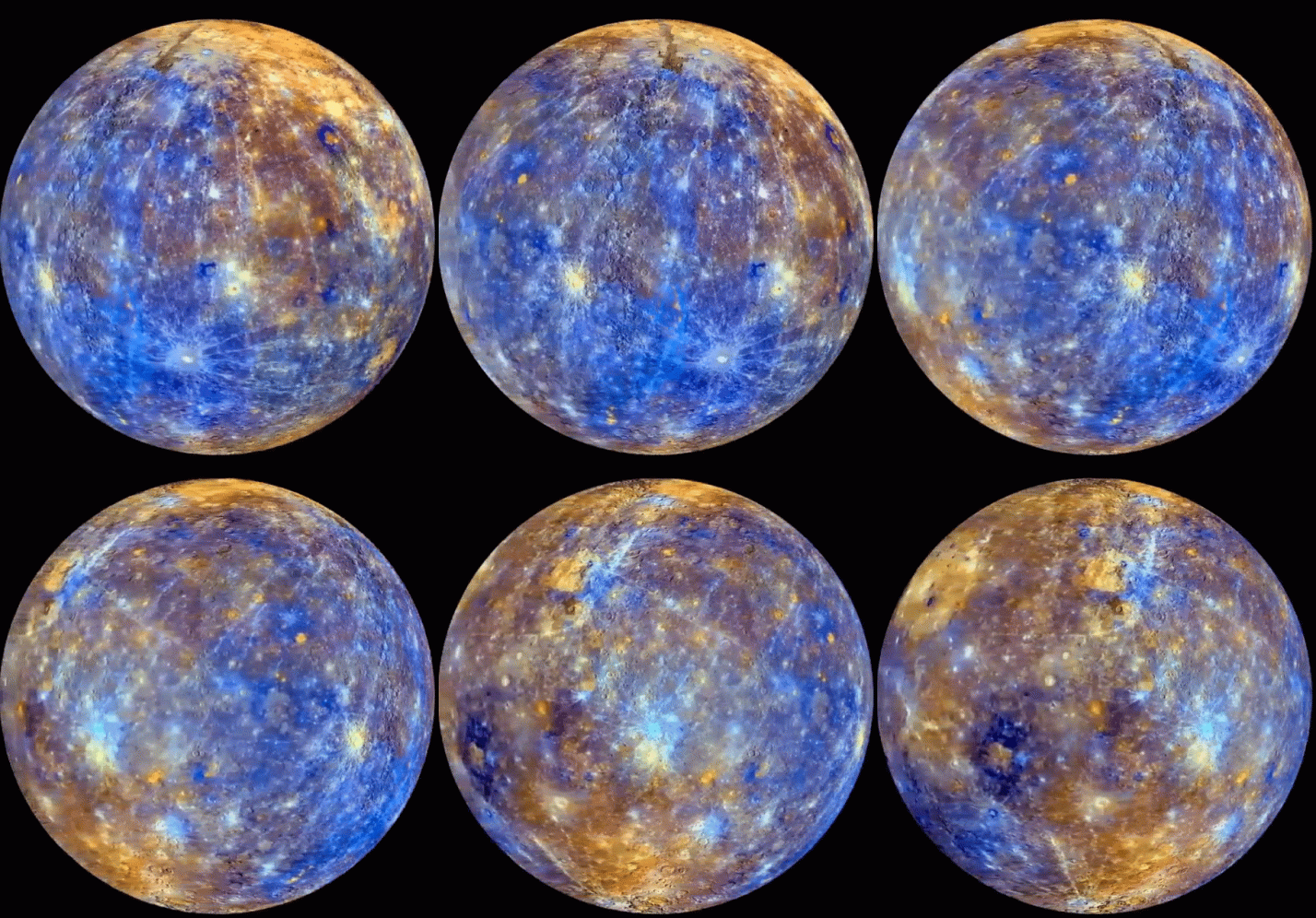
Mercury is the innermost planet of the Solar System and the smallest of the eight major planets, known for its heavily cratered surface, extreme day-night temperature differences, and rapid orbital motion around the Sun.
📍 Basic Overview
🌍 Diameter: About 7,926 miles (12,756 km) at the equator.
📏 Circumference: Roughly 24,900 miles (40,000 km).
⚖️ Mass: Approximately 5.97 × 10²⁴ kg.
🧲 Density: About 5.51 g/cm³, making Earth the densest planet in the Solar System.
⏳ Age: About 4.54–4.5 billion years old.
🌞 Formation: Formed about 4.5 billion years ago from the solar nebula as dust and gas accreted into a rocky planet.
🧱 Internal Layers: A thin crust, a thick mantle, a liquid outer core made mostly of molten iron and nickel, and a solid inner core.
🌊 Surface Composition: About 71% water and 29% land.
🌬️ Atmosphere: Mostly nitrogen (78%) and oxygen (21%), with small amounts of argon, carbon dioxide, and other gases.
🌡️ Average Surface Temperature: Around 59°F (15°C), moderated by the atmosphere and greenhouse effect.
🔥 Core Temperature: The inner core can reach roughly 9,800°F (5,400°C).
🧲 Magnetic Field: Generated by motion in the liquid outer core, creating a magnetosphere that protects Earth from solar radiation.
🛰️ Natural Satellite: One moon — the Moon.
🌡️ Temperature
🌡️ Average Surface: Around 59°F (15°C).
🔥 Core Temperature: Approximately 9,800°F (5,400°C).
☀️ Average Distance from the Sun:
About 93 million miles (149.6 million km), defined as 1 Astronomical Unit (AU) — the standard unit astronomers use to measure distances within the Solar System.
🌌 Space Environment
🧲 Magnetosphere:
Earth is surrounded by a powerful magnetic field generated by motion in the liquid outer core. This magnetosphere protects the planet by deflecting most solar wind and harmful cosmic radiation.
🌀 Magnetosphere Size:
On the Sun-facing side, it extends roughly 40,000 miles (65,000 km). On the night side, the magnetotail stretches hundreds of thousands of miles into space.
⚡ Van Allen Radiation Belts:
Two main donut-shaped zones of trapped charged particles surrounding Earth, discovered in 1958. These belts capture high-energy particles from the Sun and cosmic rays.
🌌 Auroras (Northern & Southern Lights):
When solar particles interact with Earth’s magnetic field and atmosphere, they produce auroras, visible near the polar regions as colorful light displays.
🛰️ Artificial Satellites:
More than 10,000 satellites currently orbit Earth for communications, navigation, weather monitoring, science, and defense.
☄️ Near-Earth Objects (NEOs):
Thousands of asteroids and comets have orbits that approach Earth. Space agencies continuously track these objects to monitor potential impact risks.
🌊 Hydrosphere Statistics
💧 Total Water Volume:
About 332 million cubic miles (1.386 billion km³) of water exists on Earth.
🌊 Ocean Coverage:
Approximately 71% of Earth's surface is covered by oceans.
🌍 Ocean Volume:
The oceans contain about 321 million cubic miles (1.332 billion km³) of water.
📏 Average Ocean Depth:
Roughly 12,100 feet (3,688 meters).
🌊 Deepest Ocean Point:
The Challenger Deep in the Mariana Trench, reaching about 36,070 feet (10,994 meters) below sea level.
💧 Freshwater Percentage:
Only about 2.5% of Earth's water is freshwater.
🧊 Frozen Freshwater:
About 69% of Earth's freshwater is locked in glaciers and ice caps.
🏞️ Accessible Freshwater:
Less than 1% of Earth's total water is available in rivers, lakes, and groundwater usable by humans.
Mercury Sounds:
⚠️ Disclaimer on Planetary “Sounds”
Space is a near vacuum, which means sound waves cannot travel the way they do through air on Earth. Because of this, planets themselves cannot be “heard” directly in space by human ears. However, scientists have recorded various radio waves, plasma vibrations, and electromagnetic signals around planets using spacecraft instruments.
These signals are often converted into audible sound frequencies through a process called sonification, allowing humans to listen to them. Missions from agencies such as NASA and other space programs have captured these signals from planets across the Solar System.
The sounds often described as “planet sounds” are therefore scientific interpretations of space data, translated into audio so researchers and the public can better understand the dynamic environments around planets, such as solar wind interactions, magnetospheres, and atmospheric activity.
🌍 Geography and Natural Features
Earth’s geography is incredibly diverse, shaped by tectonic activity, erosion, climate, and billions of years of geological processes. The planet’s surface includes continents, oceans, mountains, rivers, deserts, forests, glaciers, and countless other natural features that together form the landscapes of the world. These features influence climate, ecosystems, and the distribution of life across the planet, making Earth one of the most dynamic and complex worlds in the Solar System.
🗺️ Continents
🗺️ Number of Continents: Earth has 7 continents — Africa, Antarctica, Asia, Europe, North America, South America, and Australia (often grouped with Oceania).
🌏 Largest Continent: Asia, covering about 17.2 million sq mi (44.6 million km²) and home to roughly 60% of the world’s population.
🌍 Second Largest Continent: Africa, covering about 11.7 million sq mi (30.3 million km²) and known for its vast deserts, savannas, and rainforests.
🌎 Smallest Continent: Australia, covering about 2.97 million sq mi (7.7 million km²).
❄️ Coldest Continent: Antarctica, the coldest, driest, and windiest continent, covered by a massive ice sheet.
👥 Most Populated Continent: Asia, with more than 4.7 billion people.
🌊 Least Populated Continent: Antarctica, which has no permanent population, only temporary scientific research stations.
🌍 Continental Land Coverage: The continents together cover about 29% of Earth’s surface, with the remaining 71% covered by oceans.
🌊 Oceans and Seas
🌊 Global Ocean: Earth has one interconnected global ocean covering about 71% of the planet’s surface.
🌍 Five Major Oceans:
Pacific Ocean
Atlantic Ocean
Indian Ocean
Arctic Ocean
Southern (Antarctic) Ocean
📜 Southern Ocean: The Southern Ocean surrounding Antarctica has been formally recognized more recently by many geographic and scientific organizations, distinguishing it from the southern portions of the Pacific, Atlantic, and Indian Oceans.
🌊 Largest Ocean: The Pacific Ocean, covering about 63 million sq mi (165 million km²), making it the largest and deepest ocean on Earth.
🌊 Second Largest Ocean: The Atlantic Ocean, covering about 41 million sq mi (106 million km²) and separating the Americas from Europe and Africa.
🌊 Third Largest Ocean: The Indian Ocean, covering about 27 million sq mi (70 million km²) and bordered by Asia, Africa, and Australia.
🌊 Smallest Ocean: The Arctic Ocean, covering about 5.4 million sq mi (14 million km²) and largely surrounded by Arctic landmasses.
🌊 Deepest Ocean Point: Challenger Deep in the Mariana Trench, about 36,000 ft (10,984 m) below sea level, the deepest known point in Earth’s oceans.
🌊 Longest Underwater Mountain Chain: The Mid-Ocean Ridge, stretching about 40,000 miles (65,000 km) across the ocean floor, forming the longest mountain system on Earth.
🌊 Largest Coral Reef System: The Great Barrier Reef off the coast of Australia, stretching about 1,430 miles (2,300 km) and consisting of nearly 3,000 individual reefs.
🌊 Average Ocean Depth: The average depth of Earth’s oceans is about 12,080 ft (3,682 m).
🌊 Ocean Water Volume: Earth’s oceans contain about 321 million cubic miles (1.332 billion km³) of water, holding about 97% of all water on the planet.
🌊 Ocean Currents: Major ocean currents such as the Gulf Stream help regulate global climate by redistributing heat around the planet.
🌊 Seas
🌐 Number of Seas: Geographers recognize about 50–70+ seas, defined as portions of oceans partially enclosed by land. The International Hydrographic Organization (IHO) lists more than 70 bodies of water designated as seas.
🌍 Largest Sea: The Philippine Sea, covering about 2.2 million sq mi (5.7 million km²) in the western Pacific Ocean.
🌊 Smallest Sea: The Sea of Marmara in Turkey, covering about 4,380 sq mi (11,350 km²) and connecting the Black Sea and the Aegean Sea.
🧂 Saltiest Major Sea: The Red Sea, known for its very high salinity due to strong evaporation and limited freshwater inflow.
🌡 Warmest Sea: The Red Sea, which maintains very warm water temperatures year-round, often exceeding 86°F (30°C) in some areas.
📖 “Seven Seas”: A historic poetic term that has referred to different groups of seas or oceans throughout history, and today is often used symbolically to describe the world’s oceans.
🌊 Bays and Gulfs
🌊 Largest Gulf: The Gulf of Mexico, covering about 615,000 sq mi (1.6 million km²).
🌊 Largest Bay: The Bay of Bengal, part of the northeastern Indian Ocean and the largest bay in the world.
🌊 Second Largest Bay: The Hudson Bay in Canada, covering about 475,000 sq mi (1.23 million km²) and connected to the Arctic Ocean.
🌊 Deepest Gulf: The Gulf of California (Sea of Cortez) between Mexico’s Baja California Peninsula and mainland Mexico, reaching depths of about 12,000 ft (3,650 m).
🌊 Largest Semi-Enclosed Gulf: The Persian Gulf, covering about 97,000 sq mi (251,000 km²) and bordered by several countries in the Middle East.
🌊 Coldest Major Bay: Hudson Bay, which freezes over for several months each year due to its northern latitude and Arctic climate.
🏝️ Islands
🏝 Largest Island: Greenland, with an area of about 836,330 sq mi (2,166,086 km²), is the largest island in the world that is not classified as a continent.
Although Australia is completely surrounded by water and might appear to qualify as the world’s largest island, geographers classify it as a continent rather than an island. Australia has a land area of about 2,968,401 sq mi (7,688,126 km²), making it nearly 3.6 times larger than Greenland.
The distinction exists mainly because continents are considered major tectonic landmasses with their own continental crust and geological structure, whereas islands are typically smaller landmasses that sit on continental shelves or oceanic crust. Greenland lies on the North American continental plate, meaning it is geologically part of the North American continent rather than a separate continental body.
Because of this convention:
• Australia → classified as the smallest continent
• Greenland → classified as the largest island
If continents were counted as islands, the largest “island” on Earth would actually be the enormous connected landmass known as Afro-Eurasia, which combines Africa, Europe, and Asia into one continuous landmass. Afro-Eurasia covers about 30.8 million sq mi (≈79,800,000 km²), making it the largest contiguous landmass on Earth.
However, since continents are treated as a separate geographic category, Greenland officially holds the title of the largest island in the world.
🏝 Largest Archipelago: The Malay Archipelago, containing more than 25,000 islands across Southeast Asia, including Indonesia, the Philippines, and parts of Malaysia.
🌍 Country with the Most Islands: Sweden, with about 267,570 islands, though only a small fraction are inhabited. Many of these islands are located in large freshwater lakes such as Lake Vänern, Lake Vättern, and Lake Mälaren, as well as along Sweden’s Baltic Sea coastline and archipelagos. Because Sweden counts both coastal and lake islands, the total number of islands in the country is exceptionally high.
🇮🇩 Largest Island Country: Indonesia, an archipelagic nation consisting of more than 17,000 islands, making it one of the most geographically complex island nations on Earth. Unlike Sweden, most of Indonesia’s islands are oceanic islands spread across the Pacific and Indian Oceans, forming one of the largest island chains in the world.
🏝 Largest River Island: Majuli Island in the Brahmaputra River in India, one of the largest inhabited river islands in the world.
🌋 Largest Volcanic Island: Iceland, formed largely by volcanic activity along the Mid-Atlantic Ridge, where the North American and Eurasian tectonic plates meet.
🏔️ Mountains
🏔️ Highest Mountain Above Sea Level: Mount Everest, rising 29,032 ft (8,849 m) above sea level in the Himalayas on the border of Nepal and China. It is officially considered the highest mountain on Earth because elevations are measured from sea level.
🌋 Tallest Mountain from Base to Summit: Mauna Kea in Hawaii rises about 33,500 ft (10,210 m) from its base on the Pacific Ocean floor to its summit. However, only 13,803 ft (4,207 m) of the mountain stands above sea level, which is why it is not officially listed as the tallest mountain even though its total height exceeds Mount Everest.
🌎 Farthest Mountain from Earth's Center: Mount Chimborazo in Ecuador reaches 20,548 ft (6,263 m) above sea level. Because the Earth bulges outward at the equator, Chimborazo’s summit is actually the farthest point on Earth from the planet’s center, about 1.3 miles (2.1 km) farther than Mount Everest’s summit.
🏔 Largest Mountain Range: The Mid-Ocean Ridge, an underwater mountain system stretching about 40,000 miles (65,000 km) around the globe.
🏔 Longest Mountain Range on Land: The Andes Mountains, stretching about 4,300 miles (7,000 km) along the western edge of South America..
⬇️ Lowest Points
⬇️ Lowest Land Point: The Dead Sea shoreline between Israel, Palestine, and Jordan, about −1,410 ft (−430 m) below sea level.
🌊 Deepest Ocean Point: Challenger Deep in the Mariana Trench, about 36,000 ft (10,984 m) below sea level.
🌧️🌵 Wettest and Driest Places
🌧 Wettest Place on Earth: Mawsynram, India, receiving an average of about 467 inches (11,871 mm) of rainfall per year.
🌵 Driest Place on Earth: The Atacama Desert in Chile, where some weather stations have recorded no measurable rainfall for decades, making it the driest non-polar place on Earth.
🌲 Forests
🌲 Largest Forest: The Amazon Rainforest, the largest tropical rainforest in the world, covering about 2.1 million sq mi (5.5 million km²) across South America. It is also one of the most biodiverse regions on Earth, home to millions of plant and animal species.
🌲 Largest Boreal Forest: The Taiga (Boreal Forest), stretching across Canada, Alaska, Russia, and Scandinavia, covering about 6.6 million sq mi (17 million km²) and forming the largest land biome on Earth.
🌳 Oldest Forest Ecosystems: Some of the oldest forests on Earth are found in Tasmania, Australia, where certain forest ecosystems have existed for over 180 million years.
🌿 Most Biodiverse Forest: The Amazon Rainforest, which contains an estimated 10% of all known species on Earth.
🌎 Forest Coverage on Earth: Forests cover about 31% of Earth’s land area, playing a major role in absorbing carbon dioxide, producing oxygen, and supporting global ecosystems.
🌴 Largest Temperate Rainforest: The Pacific Temperate Rainforest along the northwestern coast of North America, stretching from California through Alaska, known for its massive trees and dense ecosystems.
🏜️ Deserts
🏜️ Largest Desert: Antarctica, covering about 5.5 million sq mi (14.2 million km²), is the largest desert on Earth because it receives extremely little precipitation, classifying it as a cold desert.
🏜Largest Sand Desert: The Sahara Desert in North Africa, covering about 3.6 million sq mi (9.2 million km²). While Antarctica is the largest desert overall, the Sahara is the largest hot sand desert on Earth.
🌵 Driest Non-Polar Desert: The Atacama Desert in Chile, where some weather stations have recorded no measurable rainfall for decades.
🌍 Largest Desert in Africa: The Sahara Desert, covering about 3.6 million sq mi (9.2 million km²) across North Africa.
🌏 Largest Desert in Asia: The Arabian Desert, covering about 900,000 sq mi (2.3 million km²) across the Arabian Peninsula.
🌎 Largest Desert in North America: The Chihuahuan Desert, covering about 140,000 sq mi (362,000 km²) across Mexico and the southwestern United States.
🌎 Largest Desert in South America: The Patagonian Desert, covering about 260,000 sq mi (670,000 km²) across Argentina.
🌏 Largest Desert in Australia: The Great Victoria Desert, covering about 163,000 sq mi (422,000 km²) across Western Australia and South Australia.
🌍 Largest Desert in Europe: The Bardenas Reales, a semi-arid desert region in Spain, covering about 16 sq mi (42 km²).
❄️ Largest Desert in Antarctica: The Antarctic Desert, which covers nearly the entire Antarctic continent.
🌍 Desert Coverage on Earth: Deserts cover roughly one-third of Earth’s land surface, including both hot and cold deserts.
🌿 Wetlands
🌿 Largest Wetland: The Pantanal in South America, spanning parts of Brazil, Bolivia, and Paraguay, covering about 75,000 sq mi (195,000 km²). It is one of the most biologically diverse wetlands on Earth, home to thousands of plant and animal species.
🌎 Largest Wetland in South America: The Pantanal, covering about 75,000 sq mi (195,000 km²) across Brazil, Bolivia, and Paraguay.
🌎 Largest Wetland in North America: The Hudson Bay Lowlands in Canada, covering about 124,000 sq mi (321,000 km²), one of the largest wetland ecosystems in the world.
🌍 Largest Wetland in Africa: The Sudd Wetland in South Sudan, covering about 22,000 sq mi (57,000 km²) during the rainy season.
🌏 Largest Wetland in Asia: The West Siberian Lowland Wetlands in Russia, covering more than 1 million sq mi (2.6 million km²), making it the largest wetland system on Earth.
🌏 Largest Wetland in Europe: The Pripyat Marshes (Polesia) spanning Belarus and Ukraine, covering about 40,000 sq mi (≈104,000 km²).
🌏 Largest Wetland in Australia/Oceania: The Kakadu Wetlands in Northern Australia, covering about 7,700 sq mi (≈20,000 km²) and known for their rich biodiversity and seasonal floodplains.
❄️ Largest Wetland in Antarctica: Small coastal wetland areas and meltwater wetlands occur during the Antarctic summer, though they are very limited due to the continent’s extreme climate.
🌍 Global Wetland Coverage: Wetlands cover roughly 6% of Earth’s land surface but support a large share of the planet’s biodiversity and help regulate water systems, flood control, and carbon storage.
❄️ Snow and Ice
❄️ Largest Ice Sheet: The Antarctic Ice Sheet, covering about 5.4 million sq mi (14 million km²) and containing roughly 90% of the world’s ice and about 70% of Earth’s freshwater.
❄️ Largest Glacier (outside ice sheets): The Lambert Glacier in Antarctica, about 250 miles (400 km) long and one of the largest glaciers in the world.
❄️ Second Largest Ice Sheet: The Greenland Ice Sheet, covering about 656,000 sq mi (1.7 million km²) and containing roughly 10% of the world’s ice.
❄️ Largest Ice Shelf: The Ross Ice Shelf in Antarctica, covering about 182,000 sq mi (472,000 km²), making it the largest floating ice shelf on Earth.
❄️ Largest Iceberg Ever Recorded: Iceberg B-15, which broke off the Ross Ice Shelf in 2000, measuring about 4,200 sq mi (10,900 km²) — larger than the island of Jamaica.
❄️ Most Glaciers: Alaska contains more than 100,000 glaciers, more than anywhere else in the United States.
🌊 Lakes
🌊 Largest Lake: The Caspian Sea, about 143,000 sq mi (371,000 km²). Despite its name, it is technically the largest inland lake in the world.
🌊 Deepest Lake: Lake Baikal in Siberia, Russia, reaching a depth of about 5,387 ft (1,642 m). It also contains about 20% of the world’s unfrozen freshwater.
🌲 Largest Island Lake: Lake Manitou on Manitoulin Island in Canada, the largest lake located on an island.
🌎 Country with the Most Lakes: Canada, which has over 2 million lakes and contains about 20% of the world’s freshwater.
🇺🇸 U.S. State with the Most Lakes: Alaska, with over 3 million lakes, including more than 3,000 lakes larger than 20 acres.
🇨🇦 Canadian Province/Territory with the Most Lakes: Ontario, which has over 250,000 lakes, more than any other province or territory in Canada.
🌍 Largest Lake in Africa: Lake Victoria, covering about 26,600 sq mi (68,800 km²) and shared by Tanzania, Uganda, and Kenya.
🌏 Largest Lake in Asia: The Caspian Sea, covering about 143,000 sq mi (371,000 km²) and bordered by Russia, Kazakhstan, Turkmenistan, Iran, and Azerbaijan.
🌎 Largest Lake in North America: Lake Superior, covering about 31,700 sq mi (82,100 km²) and shared by the United States and Canada.
🌎 Largest Lake in South America: Lake Maracaibo in Venezuela, covering about 5,100 sq mi (13,200 km²).
🌍 Largest Lake in Europe: Lake Ladoga in Russia, covering about 6,700 sq mi (17,700 km²).
🌏 Largest Lake in Australia/Oceania: Lake Eyre (Kati Thanda–Lake Eyre) in Australia, covering up to about 3,668 sq mi (9,500 km²) when filled, though it is usually dry or partially filled.
❄️ Largest Lake in Antarctica: Lake Vostok, a massive subglacial lake buried beneath about 2.5 miles (4 km) of ice, covering about 4,830 sq mi (12,500 km²).
🌊 Rivers
🌊 Longest River: The Nile River, about 4,135 miles (6,650 km) long, flowing through northeastern Africa into the Mediterranean Sea. (Some studies suggest the Amazon River may be slightly longer depending on how its source is measured.)
🌊 Largest River by Volume: The Amazon River, which carries more water than any other river on Earth and discharges about 209,000 m³ of water per second into the Atlantic Ocean.
🌍 Longest River in Africa: The Nile River, about 4,135 miles (6,650 km) long, flowing through 11 countries before reaching the Mediterranean Sea.
🌏 Longest River in Asia: The Yangtze River in China, about 3,915 miles (6,300 km) long and the longest river in Asia.
🌎 Longest River in North America: The Missouri River, about 2,341 miles (3,767 km) long, a major tributary of the Mississippi River.
🌎 Longest River in South America: The Amazon River, about 4,000 miles (≈6,400 km) long and the largest river system in the world by water discharge.
🌍 Longest River in Europe: The Volga River in Russia, about 2,294 miles (3,692 km) long and the longest river in Europe.
🌏 Longest River in Australia/Oceania: The Murray River in Australia, about 1,558 miles (2,508 km) long.
❄️ Longest River in Antarctica: The Onyx River, about 20 miles (32 km) long, the longest river in Antarctica, flowing during the Antarctic summer.
🌊 Largest River Delta: The Ganges–Brahmaputra Delta in Bangladesh and India, covering about 40,000 sq mi (≈100,000 km²) and forming the largest river delta on Earth.
🏝️ Peninsulas and Isthmuses
🏝 Largest Peninsula: The Arabian Peninsula, covering about 1.25 million sq mi (3.2 million km²) in Southwest Asia.
🌍 Largest Peninsula in Europe: The Scandinavian Peninsula, covering about 289,500 sq mi (750,000 km²) and including Norway, Sweden, and part of Finland.
🌏 Largest Peninsula in Asia: The Arabian Peninsula, the largest peninsula in the world, bordered by the Red Sea, Arabian Sea, and Persian Gulf.
🌎 Largest Peninsula in North America: The Labrador Peninsula in Canada, covering about 540,000 sq mi (1.4 million km²).
🌎 Largest Peninsula in South America: The Guajira Peninsula, located between Colombia and Venezuela, extending into the Caribbean Sea.
🌍 Largest Peninsula in Africa: The Somali Peninsula (Horn of Africa), extending into the Indian Ocean and including Somalia, Ethiopia, Eritrea, and Djibouti.
🌏 Largest Peninsula in Australia/Oceania: The Cape York Peninsula in northern Australia, covering about 112,000 sq mi (289,000 km²).
🌍 Famous Isthmus: The Isthmus of Panama, a narrow land bridge about 40 miles (64 km) wide at its narrowest point, connecting North and South America and separating the Atlantic and Pacific Oceans.
🌏 Another Major Isthmus: The Isthmus of Suez in Egypt, connecting Africa and Asia and home to the Suez Canal, one of the world’s most important shipping routes..
🌋 Volcanoes
🌋 Volcanoes: Earth has about 1,350 potentially active volcanoes, most located along tectonic plate boundaries, especially around the Pacific Ring of Fire.
🌋 Largest Volcano: Mauna Loa in Hawaii, covering about 5,271 sq km (2,035 sq mi) and rising about 33,500 ft (10,210 m) from its base on the ocean floor, making it the largest volcano on Earth by volume and area.
🌋 Tallest Volcano Above Sea Level: Ojos del Salado, located on the border of Chile and Argentina, rising 22,615 ft (6,893 m) above sea level, making it the highest volcano on Earth.
🌋 Most Active Volcano: Kīlauea in Hawaii, one of the most active volcanoes in the world, with frequent eruptions over the past several centuries.
🌋 Largest Volcanic Eruption in Recorded History: Mount Tambora in Indonesia, which erupted in 1815, causing the “Year Without a Summer” in 1816 due to massive volcanic ash released into the atmosphere.
🌋 Supervolcano: The Yellowstone Caldera in the United States, one of the largest known volcanic systems on Earth, capable of producing extremely large eruptions thousands of times more powerful than typical volcanic events.
🪨 Tectonics
🪨 Tectonic Plates: Earth’s crust is divided into major and minor tectonic plates that slowly move, shaping continents, mountains, earthquakes, and volcanoes.
🌍 Plate Tectonics: Earth is the only known planet with active plate tectonics, continually reshaping its surface over millions of years.
✨ Rare Facts
🌎 Largest Continuous Mountain System: The Global Mid-Ocean Ridge, an underwater mountain system stretching about 40,000 miles (65,000 km) across Earth’s ocean floors. It forms where tectonic plates pull apart and new crust is created by volcanic activity, making it the longest mountain system on Earth and one of the most geologically active regions on the planet.
🕳 Deepest Known Artificial Hole on Earth: The Kola Superdeep Borehole in Russia reached a depth of about 40,230 ft (12,262 m) during a scientific drilling project that studied Earth’s crust.
🌍 Largest Continental Shelf: The Siberian (Arctic) Continental Shelf, the broad shallow underwater extension of northern Russia, covering about 1.5 million sq mi (3.9 million km²).
🌊 Largest Ocean Gyre: The North Pacific Gyre, a massive circular system of ocean currents covering millions of square miles in the North Pacific Ocean.
🌋 Largest Volcanic Eruption in Recorded History: The 1815 eruption of Mount Tambora in Indonesia, which caused the “Year Without a Summer” in 1816 due to volcanic ash blocking sunlight worldwide.
🌍 Oldest Known Rocks on Earth: The Acasta Gneiss in Canada, estimated to be about 4.03 billion years old, among the oldest rocks ever discovered on the planet.
🌪 Strongest Tornado Ever Recorded: The Tri-State Tornado of 1925 in the United States, which traveled about 219 miles (352 km) across Missouri, Illinois, and Indiana.
🌊 Largest Coral Reef System: The Great Barrier Reef off the coast of Australia, stretching about 1,430 miles (2,300 km) and consisting of nearly 3,000 individual reefs, making it the largest coral reef system on Earth.
🌋 Largest Lava Flow Field: The Deccan Traps in India, covering about 200,000 sq mi (500,000 km²) today and formed by massive volcanic eruptions about 66 million years ago.
🌎 Earth’s Highest Gravity Variation: Gravity varies slightly across Earth’s surface due to differences in density and elevation, with some of the strongest gravitational anomalies found in the Indian Ocean region.
🧭 Largest Magnetic Field Anomaly: The South Atlantic Anomaly, a region where Earth’s magnetic field is weaker, affecting satellites passing through the area.
🌊 Earth’s Water Is a Tiny Fraction of the Planet:
If all the water on Earth were gathered into a single sphere, it would form a ball only about 860 miles (1,385 km) in diameter — surprisingly small compared to Earth’s 7,926-mile (12,756 km) diameter.
🌍 Earth Is Not a Perfect Sphere:
Earth is actually an oblate spheroid, meaning it bulges at the equator due to its rotation. The planet’s equatorial diameter is about 27 miles (43 km) wider than its pole-to-pole diameter.
🪙 Gold in the Oceans:
Earth’s oceans contain an estimated 20 million tons of dissolved gold. However, the gold is so diluted (about 13 parts per quadrillion) that it is currently impossible to extract economically.
🌍 Continents Are Constantly Moving:
Earth’s tectonic plates move about as fast as fingernails grow, typically 1–4 inches (2–10 cm) per year. Over millions of years, this slow movement reshapes continents and oceans through continental drift.
🌊 The Ocean Holds Most of Earth’s Living Space:
Even though oceans cover 71% of Earth’s surface, they account for about 99% of the planet’s habitable living space by volume, because life can exist throughout the deep water column.
🌟 Unique Planetary Facts
🌊 Liquid Water Coverage: Earth is the only known planet with stable liquid water oceans on its surface, with about 71% of the planet covered by water. This vast global ocean plays a critical role in regulating climate, supporting life, and shaping Earth’s geology through erosion, weather systems, and the water cycle.
🌬 Protective Atmosphere and Magnetosphere: Earth has a thick atmosphere and a strong magnetic field that shield the surface from harmful solar radiation and cosmic particles, helping maintain conditions suitable for life.
🌍 Only Known Planet with Life: Earth is currently the only known world in the universe confirmed to host life, with millions of species living across land, oceans, and the atmosphere.
🌡 Habitable Temperature Range: Earth lies within the Sun’s habitable zone, where temperatures allow liquid water to remain stable on the surface, a key requirement for life as we know it.
🧬 Biodiversity: Earth hosts an estimated 8.7 million species of living organisms, making it the most biologically diverse planet known.
🌿 Oxygen-Rich Atmosphere: Earth’s atmosphere contains about 21% oxygen, produced largely by photosynthetic organisms such as plants, algae, and cyanobacteria.
🌙 Large Stabilizing Moon: Earth has an unusually large natural satellite, the Moon, which helps stabilize the planet’s axial tilt and contributes to tides in the oceans.
🌎 Active Plate Tectonics: Earth is the only known planet with active plate tectonics, continuously reshaping the surface through continental drift, mountain building, earthquakes, and volcanism.
🌧 Dynamic Water Cycle: Earth has a complex global water cycle, where water continuously moves between oceans, atmosphere, rivers, glaciers, and groundwater.
🧲 Global Magnetic Shield: Earth’s magnetosphere protects the planet from the solar wind, preventing the atmosphere from being stripped away as happened on planets like Mars.
🌍 Blue Planet: From space, Earth appears predominantly blue due to its vast oceans, earning it the nickname “The Blue Planet.”
🌱 Self-Regulating Climate System: Earth’s climate is influenced by oceans, atmosphere, biosphere, and geology, forming a complex system that helps moderate global temperatures over long periods of time.
🌍 Habitable World
🌎 Number of Continents: 7
Africa
Antarctica
Asia
Europe
North America
South America
Australia (often grouped with Oceania)
These continents contain Earth’s major landmasses and the vast majority of the planet’s population.
🌏 Largest Continent: Asia, covering about 17.2 million sq mi (44.6 million km²) and home to roughly 60% of the world’s population.
🌍 Second Largest Continent: Africa, covering about 11.7 million sq mi (30.3 million km²) and spanning both the Northern and Southern Hemispheres.
🌎 Smallest Continent: Australia, covering about 2.97 million sq mi (7.7 million km²).
❄️ Coldest Continent: Antarctica, the coldest, driest, and windiest continent, with temperatures dropping below −128.6°F (−89.2°C).
👥 Most Populous Continent: Asia, with more than 4.7 billion people.
🌍 Least Populated Continent: Antarctica, which has no permanent population, only temporary research stations.
🌊 Continental Land Coverage: The continents together cover about 29% of Earth’s surface, while the remaining 71% is covered by oceans.
🌍 Largest Continuous Landmass: Afro-Eurasia, the connected landmass of Africa, Europe, and Asia, covering about 30.8 million sq mi (≈79.8 million km²).
🌍 Only Continent Without Rivers: Antarctica, where most water is locked in ice sheets and glaciers.
🌎 Continent Crossing All Hemispheres: Africa, the only continent that extends into the Northern, Southern, Eastern, and Western Hemispheres.
🏳️ Countries
🌐 Number of Countries: There are roughly 193–197 sovereign states in the world, depending on the method of political recognition.
• 193 member states of the United Nations
• 2 UN observer states: Vatican City and Palestine
Some counts include partially recognized states such as Taiwan or Kosovo, which is why totals may range from 193 to about 197 countries depending on political and diplomatic recognition standards.
🌍 Largest Country by Area: Russia, covering about 6.6 million sq mi (17.1 million km²) and spanning Europe and Asia.
🌏 Most Populous Country: India, with a population of over 1.4 billion people.
🏝 Smallest Country: Vatican City, covering only about 0.19 sq mi (0.49 km²) within Rome, Italy.
🌐 Country with the Most Time Zones: France, with 12 time zones due to its overseas territories around the world.
🌍 Country with the Longest Coastline: Canada, with about 151,600 miles (244,000 km) of coastline.
🌎 Largest Landlocked Country: Kazakhstan, covering about 1.05 million sq mi (2.7 million km²) without access to an ocean.
🏝 Largest Island Country: Indonesia, consisting of more than 17,000 islands across Southeast Asia.
🌍 Youngest Recognized Country: South Sudan, which became independent in 2011.
🏝️ Overseas Territories
🌍 Number of Overseas Territories: Roughly 60–100 territories worldwide.
These are regions politically associated with a distant sovereign country but not fully independent nations. They often have varying levels of autonomy, including their own local governments, legal systems, or special administrative arrangements.
Examples include:
• Puerto Rico (United States)
• Greenland (Denmark)
• French Polynesia (France)
• Bermuda (United Kingdom)
The range varies because some lists include dependencies, autonomous regions, and special administrative regions, while others count only formal overseas territories.
🌍 Country with the Most Overseas Territories: France, which has numerous overseas regions and collectivities located in the Caribbean, South America, Africa, the Indian Ocean, and the Pacific Ocean.
🇬🇧 United Kingdom Territories: The United Kingdom has 14 British Overseas Territories, including Gibraltar, the Falkland Islands, and the Cayman Islands.
🇺🇸 United States Territories: The United States has several territories in the Caribbean and Pacific, including Puerto Rico, Guam, the U.S. Virgin Islands, American Samoa, and the Northern Mariana Islands.
🌏 Largest Overseas Territory by Area: Greenland (Denmark), covering about 836,330 sq mi (2,166,086 km²).
🏝 Smallest Overseas Territory: Pitcairn Islands (United Kingdom), covering only about 18 sq mi (47 km²) and having one of the smallest populations in the world.
🌍 Strategic Importance: Many overseas territories are located in strategic ocean regions, giving their parent countries expanded maritime zones and exclusive economic zones (EEZs) for fishing, shipping, and resources.
🏙️ Cities, Towns, and Villages
🏙 Cities: Estimates suggest 10,000+ cities worldwide, depending on how “city” is defined by each country’s legal or administrative system.
🏘 Towns: There are likely hundreds of thousands of towns globally, varying widely in population size and governance structures.
🏡 Villages and Small Settlements: There may be millions of villages and small settlements across the planet.
Because each country defines settlements differently, there is no single official global total, but collectively Earth contains millions of populated places (possibly up to 4 million) ranging from megacities to small rural villages.
🌆 Largest City by Population: Tokyo, Japan, with a metropolitan population of about 37 million people, making it the largest urban area in the world.
🏙 Most Cities in a Country: China has hundreds of officially designated cities, many with populations of over one million people.
🌏 First City in Human History: Uruk, located in ancient Mesopotamia (modern-day Iraq), considered one of the earliest major cities, flourishing around 4,000–3,000 BCE.
🌍 Megacities: There are more than 30 megacities worldwide, defined as urban areas with populations exceeding 10 million people.
🏙 Urban Population: More than 55% of the world’s population now lives in urban areas, a number expected to increase significantly during the 21st century.
🌆 Largest Planned City: Naypyidaw, the capital of Myanmar, built in the 2000s as a planned administrative capital with vast road networks and government complexes.
🌍 Urban Land Coverage: Despite the large number of settlements, urban areas cover only about 3% of Earth’s land surface, yet they contain most of the world’s population and economic activity.
⏱️ Time
🕛 Day Length: About 24 hours (solar day).
🌀 Sidereal Rotation: Earth rotates once relative to distant stars in about 23 hours, 56 minutes.
📅 Year Length: About 365.25 days to orbit the Sun.
🚀 Motion in Space
🔄 Rotation: Earth spins once every 23 hours and 56 minutes.
☀️ Orbital Speed: Travels around the Sun at about 67,000 mph (107,000 km/h).
🧭 Orbital Characteristics
These values describe Earth’s motion around the Sun and the geometry of its orbit. Orbital characteristics determine the length of the year, seasonal cycles, and Earth’s position within the Solar System.
🔁 Orbital Period:
365.256 days (sidereal year).
📐 Orbital Eccentricity:
0.0167 — Earth’s orbit is nearly circular.
📏 Axial Tilt (Obliquity):
23.44° — responsible for Earth’s seasons.
🧭 Orbital Inclination:
About ° relative to the ecliptic.
📡 Astronomical Measurements
🌞 Perihelion:
About 91.4 million miles (147.1 million km) — the point in Earth's orbit when it is closest to the Sun, occurring in early January.
🌞 Aphelion:
About 94.5 million miles (152.1 million km) — the point in Earth's orbit when it is farthest from the Sun, occurring in early July.
🚀 Escape Velocity:
About 24,901 mph (11.2 km/s) — the speed required for an object to escape Earth's gravitational pull without additional propulsion.
🧲 Surface Gravity:
Approximately 9.81 m/s², which is the gravitational acceleration experienced at Earth's surface.
🌍 Rotation Speed at the Equator:
About 1,037 mph (1,670 km/h) due to Earth's rotation.
MY BLOG
Below is all of my blogs together, from all of my sites.
Cultural Survival, 🇱🇮 Liechtenstein: Small State, Enduring Identity2026-03-18 20:26:58
A Series on Cultural Survival 4 Throughout history, many nations survived because of size,...
Cultural Survival, 🇩🇪 Germany: Identity Through Fragmentation and Reunification2026-03-18 20:25:25
A Series on Cultural Survival 4 Throughout history, some nations survived conquest. Others endured...
Cultural Survival, 🇦🇹 Austria: From Empire to Identity2026-03-18 20:23:46
A Series on Cultural Survival 4 Throughout history, some nations fought to gain power. Others...
SUBSCRIBE
Subscribe To Our Blog (News)
CONTACT ME
There are a few ways to contact me. Important phone calls and emails will be answered in 24 hours.
Office Address
Located in the USA and Europe
Phone Numbers
Email Address